To start playing padel, the best racket is not the most expensive one or the one used by a professional player. It is a forgiving racket, which pardons off-centre shots, light enough to play for an hour without fatigue, and flexible enough to send the ball without forcing. This guide helps you choose your first padel racket, then compares five models designed for beginners and listed on Amazon.co.uk on 28 November 2026, based on the characteristics stated by the brands.
The essentials in 30 seconds
- Shape: round, or oversized teardrop, for a large sweet spot.
- Face: fibreglass, more flexible and more comfortable than carbon.
- Weight: around 350 to 365 g for an adult.
- Balance: low or medium, for a racket that is easy to handle.
- Budget: no need to aim for the top of the range to learn.
What really matters for a first racket
Forgiveness. At the beginning, many balls are hit outside the centre. A round racket has a wide, centred sweet spot, it forgives these errors. An oversized teardrop keeps a large sweet spot while providing a little more power. Diamond rackets, which are more demanding, should be avoided for beginners. Our guide to padel racket shapes details these differences.
Flexibility. A fibreglass face is more flexible than carbon: the ball comes off more easily on slow shots, and vibrations are better absorbed. A soft EVA foam core works in the same way.
Weight and balance. A light racket balanced towards the handle is more manoeuvrable at the net and less tiring. Few product sheets give a precise weight: this is the case for the Dunlop Lumina (360 g) and the Smartwo (350 g, to within 10 g).
The little extras. A wrist strap properly adjusted to the wrist, a comfortable grip and a cover to carry the racket.
Round
- Balance:
- Low, towards the handle
- Sweet spot:
- Large and centred
Control and forgiveness, the pick of beginners and defenders
Teardrop
- Balance:
- Medium
- Sweet spot:
- Medium, a little higher
A balance of control and power
Diamond
- Balance:
- High, towards the head
- Sweet spot:
- Smaller and high on the face
Power on the smash, less forgiving on off-centre hits
The wider the head gets towards the top, the higher the balance moves towards the head and the higher and smaller the sweet spot becomes.
Shape
Round for control, teardrop for a middle ground, diamond for power.
Weight
Stated in grams: a lighter racket is easier to handle.
Balance
Low, towards the handle, makes the racket easier to handle; high, towards the head, gives more power.
Faces
Fibreglass is softer, carbon is stiffer.
Our selection of padel rackets for beginners
These five rackets were selected from the manufacturer and Amazon product listings. We did not play with them: the characteristics cited are those stated by the brands. The listings were checked on 28 November 2026.
Wilson Optix V2 Lite: the round one designed for learning

Wilson presents the Optix V2 Lite as a racket for learning the strokes of padel. The brand states a round shape with an enlarged sweet spot that forgives centring errors, a lightweight fibreglass face to combine comfort and response, and a light structure that reduces effort. This is our choice for starting out.
Dunlop Lumina: the round one with a stated weight

Dunlop states a round head with a large sweet spot, a graphite frame, a Pro EVA core, 360 g and a medium balance, with a 38 mm profile. It is sold exclusively on Amazon. It is also our default choice in the guide which padel racket to choose.
Head Evo Speed: the accessible teardrop
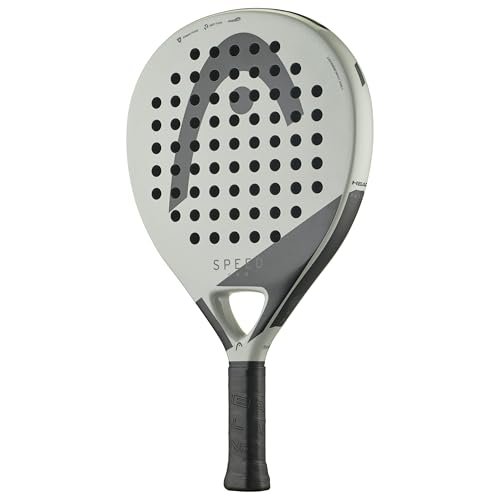
Head states a reduced weight and a lower balance for manoeuvrability, a fibreglass face for a soft touch, and an oversized teardrop with soft foam. Innegra technology is highlighted for shock absorption and stability. A good option if you want a little more power than with a round one.
Head Radical Evo: the lightweight version, Amazon exclusive

Resulting from a collaboration between Amazon and Head, the Radical Evo is stated to be lighter and rebalanced for easier handling. It uses a fibreglass face, soft foam, Innegra technology and an oversized teardrop for maximum forgiveness according to the brand.
Smartwo lightweight teardrop: for trying out on a small budget

Smartwo states a 350 g (±10 g) teardrop, an ABS hitting surface, an EVA foam core, an adjustable wrist strap and a carry case. The ABS surface is an entry-level material: this is a racket for discovering padel or for helping out a friend, less so for progressing over time.
We could not confirm this model on Amazon.co.uk on 28 November 2026: the button opens an Amazon.co.uk search, not a product page.
Search for Smartwo lightweight teardrop on Amazon.co.uk
Mistakes to avoid when starting out
- Buying a diamond racket because it is powerful: it is less forgiving and more demanding on the arm.
- Choosing a racket that is too heavy: beyond about 370 g, fatigue sets in quickly for a beginner.
- Neglecting the wrist strap: it must be tightened on the wrist for every game.
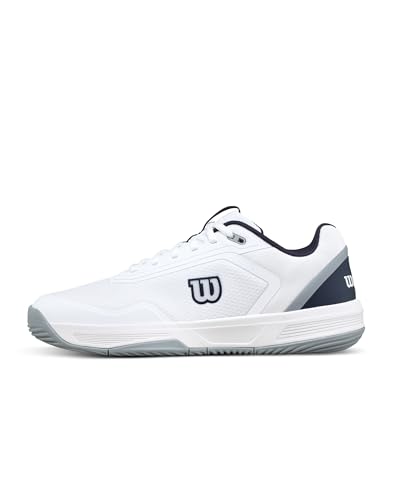
- Forgetting the shoes: on artificial turf, suitable shoes make all the difference. See our guide to padel shoes.
FAQ
What shape of padel racket for a beginner?
A round shape, or an oversized teardrop. Both offer a large sweet spot and forgive off-centre shots.
What weight for a beginner padel racket?
Around 350 to 365 g for an adult. Among our models, Dunlop states 360 g for the Lumina and Smartwo 350 g, to within 10 g. Wilson and Head do not give a precise weight in their product sheets.
Carbon or fibreglass for starting out?
Fibreglass. More flexible, it makes it easier to get the ball out and absorbs vibrations better. Carbon, which is stiffer and more precise, is appreciated when the stroke is consistent.
Sources
Characteristics recorded on 28 November 2026 from the manufacturer and Amazon product listings of the rackets mentioned (texts provided by Wilson, Dunlop, Head and Smartwo). The chart compares the shape, material and weight as stated. Wilson and Head do not state a precise weight in their product sheets: the chart indicates this as such, without an estimated value.