Which padel racket should you choose? The answer comes down to three criteria: your level, the racket's shape and its weight. The brand comes afterwards. A racket that is too demanding will not make you play better, it will simply make off-centre hits more costly. This guide helps you choose a padel racket step by step, then presents five models listed on Amazon.co.uk on 28 November 2026.
- 1
Your level
Beginner, regular or competitor: it steers everything else.
- 2
Shape
Round, teardrop or diamond, for the control or power you want.
- 3
Weight and balance
Lighter and low-balanced to spare your arm.
- 4
Faces
Fibreglass for softness, carbon for stiffness.
The essentials in 30 seconds
- Beginner: a round racket (or oversized teardrop), in fibreglass, around 355 to 365 g.
- Intermediate: a teardrop, which places the sweet spot slightly higher and provides more power.
- Advanced and attacking player: a diamond, more powerful but less forgiving, with a higher balance.
- The weight and balance matter as much as the shape: a heavy, head-heavy racket requires more effort from the arm.
Step 1: start with your level
This is the starting point for any good choice. The levels can be summarised simply:
| Level | You recognise yourself if… | What you need |
|---|---|---|
| Beginner | You have been playing for less than a year, or occasionally | Forgiveness and manoeuvrability |
| Intermediate | You play every week and master the glass walls | Balance between control and power |
| Advanced | You play in competition or several times a week | Precision or power, depending on your game |
Many players buy a competition racket too early. The models used by professional players are often stiff and designed for fast shots: they offer little forgiveness for a poorly centred hit.
Step 2: choose the racket shape
The shape determines where the sweet spot is located and the weight distribution.
Round: the sweet spot is large and located near the centre. The racket is manoeuvrable and forgiving. This is the benchmark shape for beginners and for defensive players who prioritise control.
Teardrop: the sweet spot moves slightly towards the head. The racket remains quite forgiving while gaining power. This is often the best choice for an intermediate player who wants an all-round racket.
Diamond: the sweet spot is high and smaller, the balance is shifted towards the head. You gain power on the smash and volley, at the cost of forgiveness. It is aimed at advanced and offensive players.
Round
- Balance:
- Low, towards the handle
- Sweet spot:
- Large and centred
Control and forgiveness, the pick of beginners and defenders
Teardrop
- Balance:
- Medium
- Sweet spot:
- Medium, a little higher
A balance of control and power
Diamond
- Balance:
- High, towards the head
- Sweet spot:
- Smaller and high on the face
Power on the smash, less forgiving on off-centre hits
The wider the head gets towards the top, the higher the balance moves towards the head and the higher and smaller the sweet spot becomes.
Step 3: look at the weight and balance
Most adult rackets weigh between approximately 350 and 380 g. As a guide:
- Under 360 g: more manoeuvrable, useful if you are a beginner, if you play for a long time or if you prioritise reaction speed at the net.
- 360 to 370 g: the most common range, all-round.
- Over 370 g: more stability and power, but more effort for the arm.
The balance indicates where the weight is concentrated. A low balance (towards the handle) makes the racket easier to handle. A high balance (towards the head) gives more power but is more tiring. A neutral or medium balance sits between the two.
Step 4: understand the materials
The face: fibreglass is more flexible. It gives a soft touch and easy power on slow balls, which suits beginners well. Carbon is stiffer and more precise. The higher the carbon number (3K, 12K, 18K…), the denser the weave: the racket generally gains in stiffness.
The core: it is made of EVA foam on most rackets. A soft EVA provides comfort and ball output, a hard EVA provides control and power on fast shots.
Shape
Round for control, teardrop for a middle ground, diamond for power.
Weight
Stated in grams: a lighter racket is easier to handle.
Balance
Low, towards the handle, makes the racket easier to handle; high, towards the head, gives more power.
Faces
Fibreglass is softer, carbon is stiffer.
Step 5: the brand, last
Head, Babolat, Nox, adidas, Bullpadel or Kuikma (Decathlon's padel brand) all offer rackets for every level. It is better to choose the right profile within a range than a brand's 'star' range. Model names often help: at adidas, 'Ctrl' signals a control-oriented racket, and 'Light' a lighter version.
Our selection of padel rackets
These five rackets were selected from the manufacturer and Amazon product listings, to cover the most common profiles. We did not play with these rackets: the characteristics cited are those stated by the brands.
Dunlop Lumina: the round racket for a good start

The Lumina ticks the boxes for a first racket: round head with a large sweet spot, graphite frame, Pro EVA core and 360 g with a medium balance, according to Dunlop. The 38 mm profile is standard. It is sold exclusively on Amazon and is our default choice if you do not know where to start.
Head Evo Speed: the accessible teardrop
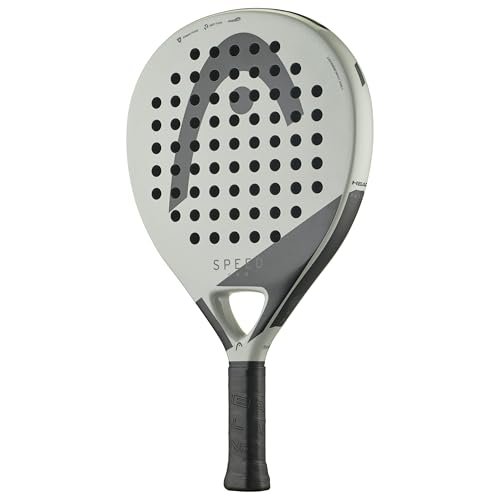
Head presents the Evo Speed as a racket for learning: a reduced weight and a lower balance for manoeuvrability, a fibreglass face for a soft touch, and an oversized teardrop shape with soft foam. Innegra technology is highlighted for shock absorption and stability. A good choice if you want a little more power than with a round racket, without losing forgiveness.
adidas Cross IT Team Ctrl 2026: for improving with control

The 'Ctrl' suffix sets the tone: this round racket in fibreglass, with a neutral balance, is aimed at players who construct the point. adidas states a 38 mm profile and classes it in its 'advanced' category. It is a logical next step after a first round racket.
NOX AT10 Genius 18K: the all-rounder for regular players

The AT10 Genius bears Agustín Tapia's name at NOX. The product listing presents its teardrop shape as a balance between power and control. '18K' is stated in the Amazon title, but the product sheet details neither the face material, nor the weight, nor the balance. A teardrop is more suited to players who already have a consistent swing. If you play several times a week and hesitate between control and attack, this is the compromise in this selection.
adidas Metalbone Team 2026: the diamond for attacking
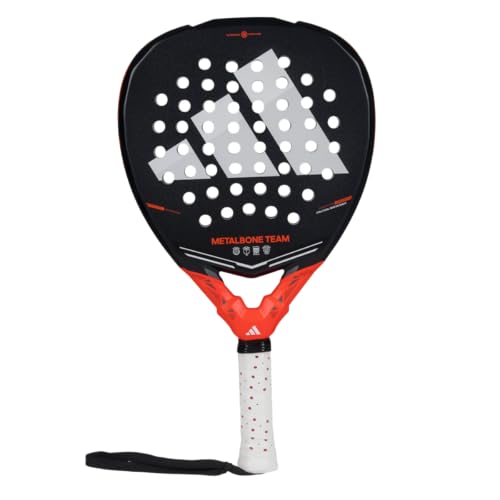
The Metalbone is adidas's power range. This Team 2026 version keeps the diamond shape and neutral balance, with a hybrid carbon and fibreglass face and 360 to 375 g stated by adidas. It will suit offensive players looking to finish the point with a smash.
We could not confirm this model on Amazon.co.uk on 28 November 2026: the button opens an Amazon.co.uk search, not a product page.
Search for adidas Metalbone Team 2026 on Amazon.co.uk
Mistakes to avoid
- Buying a professional player's racket from day one: it is designed for a different level of play.
- Choosing by looks: two rackets from the same brand can have opposite profiles.
- Ignoring the weight: a 15 g difference is felt after an hour of play.
- Forgetting protection: an adhesive frame protector limits chips against the glass walls.
Our other padel guides
- Padel racket for beginners: five easy-to-handle models for your first matches.
- Teardrop or diamond racket: understanding balance and choosing your shape.
- Padel shoes: herringbone sole, cushioning and support.
FAQ
How to choose your padel racket when you are a beginner?
Take a round or oversized teardrop racket, with a fibreglass face and a weight around 360 g. The Dunlop Lumina and the Head Evo Speed match this profile.
Which padel racket for an intermediate level?
A teardrop with a neutral balance is the most versatile choice. If you mainly play in defence, a control-oriented round racket remains a very good option.
Do you need a carbon racket?
Not for beginners. Carbon provides stiffness and precision, useful when your swing is already consistent. Fibreglass is more forgiving and more comfortable on slow balls.
Sources
Characteristics checked on 28 November 2026 on the manufacturer and Amazon product listings of the rackets mentioned (texts provided by Dunlop, Head, adidas and NOX). The chart compares the shape, material and balance as stated on these product pages. Head and NOX do not state the weight of the Evo Speed and the AT10 Genius 18K there: these weights therefore only appear in the comparison table, and only when they appear on the product page. The NOX product page does not state the balance point of the AT10 Genius 18K.